Alan Wood-Thomas' Friendship with Pablo Picasso
Alan met Pablo Picasso in Paris at La Rotonde in Montmartre, where he became deeply fascinated by both the man and his artistic vision. That encounter left a lasting impression, one that can be seen throughout much of Alan’s work.
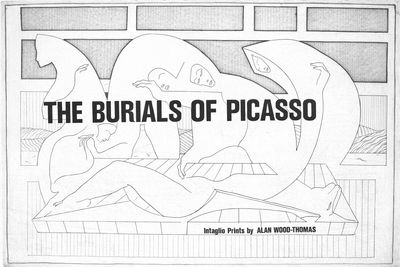
In April 1973, upon learning of Picasso’s death, Alan secluded himself in his studio in Clinton, Connecticut. Two weeks later, he emerged with a powerful suite of 15 intaglio etchings titled The Burials of Picasso. He produced only six complete sets of the series, three of which remain in the collection today.
In 2014, a longtime family friend informed us that the original copper plates used to create the series had been discovered in her father’s storage. These historic plates are now preserved as part of the Wood-Thomas Art Collection.
The Burials of Picasso - Intaglio Etching Series
Synopsis: These etchings inhabit the "historical hinge" between Picasso’s final breath and the enduring influence of his late-period style. The series moves away from narrative to focus on the raw mechanics of his last years: bodies that are stretched or fragmented, and spaces that feel increasingly tight and reflective. The work replaces the mythic energy of the early 20th century with a "quiet reckoning"—a stillness that acknowledges physical limits and the finality of time. By using an urgent, minimalist line, the series engages in a posthumous conversation with the artist’s ghost. It is less a tribute and more an exploration of the silence that follows the end of a visual era, finding a new way to speak through the remnants of a modernist tradition.